Europe changed in two generations from a patchwork of co-existing monocultures into a cosmopolitan network of increasingly diverse subcultures. The reactions to these trends are diverse. Some celebrate diversity and embrace the intercultural moment. Others feel that something essential is lost in the process, and some are unable to resist the siren call of political ideologies promising easy solutions at the expense of others.
The combination of secularisation, cultural mixing and diversification also leads to more but smaller subcultures. There are simply more combinations to make, while each combination occurs less often. If we define culture as ‘people like us do things like us’, there are simply fewer people who believe and behave like us who do things the way we do them. What used to be mainstream has become a minority. As a white Christian man, I am no longer the default for what it means to be ‘Dutch’. Mainstream culture and ‘Christianity’ no longer automatically overlap. This also means that as Christians in the West, we are increasingly living in what sociologists call a liminal state. We are in-between different subcultures, navigating what it means to be Dutch, to be Christian, and to be European.
But, and this is the crucial point, we are all there, somewhere in between, whether we are traditional Christians, nominal muslims, a random French-Chinese Buddhist, or newly converted eco-pagans. So it is crucial for us to learn how to disagree with one another and how to do that well.
Honest disagreement
In theory, we all agree that we need to find ways for dealing with disagreements, but in practise this is not so easy. There are significant cultural differences at play here. In Croatia, I noticed that people are happy to fight things out with all guns blasting. It looked like no one would survive. But once things were resolved (whatever that means), the air was clear, and people could cooperate again. This was initially all very confusing to me. In Dutch culture, we are always looking for consensus. We are together in this, and we need to talk it all out till we find an acceptable compromise.
One of the pitfalls of a consensus culture is that it might be easier to avoid disagreements by ‘agreeing to disagree’. This looks nice on the surface, but what if it is easy indifference? What if it is a culturally acceptable form of dishonesty because we do not take the reality of our disagreements seriously?
In the Dutch context, we struggle with religious disagreements because we have not learned the skill of disagreeing well. We fall back to cost-free (dis)agreements or to disagreement-masking relativism. But would it not be more honest to acknowledge the points of real disagreement? Would it not be better for our attempts at inter-religious dialogue if we found the courage to look at what we do not have in common? This is precisely the point made by Bernhard Reitsma in a recent interview in the Dutch daily newspaper Trouw.
“In your research, you use the concept of ‘exclusively inclusive.’ What do you mean by that?”
Every worldview is exclusive in a certain way. The earth is either flat or round—it cannot be both. That is exclusivity. If I support democracy, I do not support a dictatorship. The same applies to religion: if you are not convinced of your faith, it becomes diluted, and you cannot be a committed believer.
I am convinced—and I think many Muslims would agree with me—that Christianity and Islam are incompatible at certain points. They stand in opposition to each other both in content and in their way of believing. A good example is the period of fasting; it cannot simultaneously be a divine obligation and a matter of personal choice.
“What does interreligious interaction look like without descending into a culture clash?”
You have to give space to each other’s faith without judging one another. Anyone who wants a fully Christian or fully Islamic society can only achieve this through absolute power or violence. Just look at what happens in a country like Iran. You have to enforce such control through violence because you cannot coerce people’s conscience.
Precisely for this reason, Christians and Muslims should advocate for inclusivity without compromising their own faith. That is also what makes interreligious encounters so exciting. Often people say, ‘Let’s look at what we have in common.’ I would say, ‘Let’s especially look at what we do not have in common—but from a shared awareness of our humanity.’
In doing so, we must be able to honestly put our fundamental differences on the table. Otherwise, everything may seem pleasant on the surface, but conflict will still arise. In my view, many committed Muslims want this as well. After all, we have to make society work together—we are living among people who are different from ourselves.
(Translation provided by ChatGPT, full interview in Dutch here: https://archive.ph/Ea9zo)
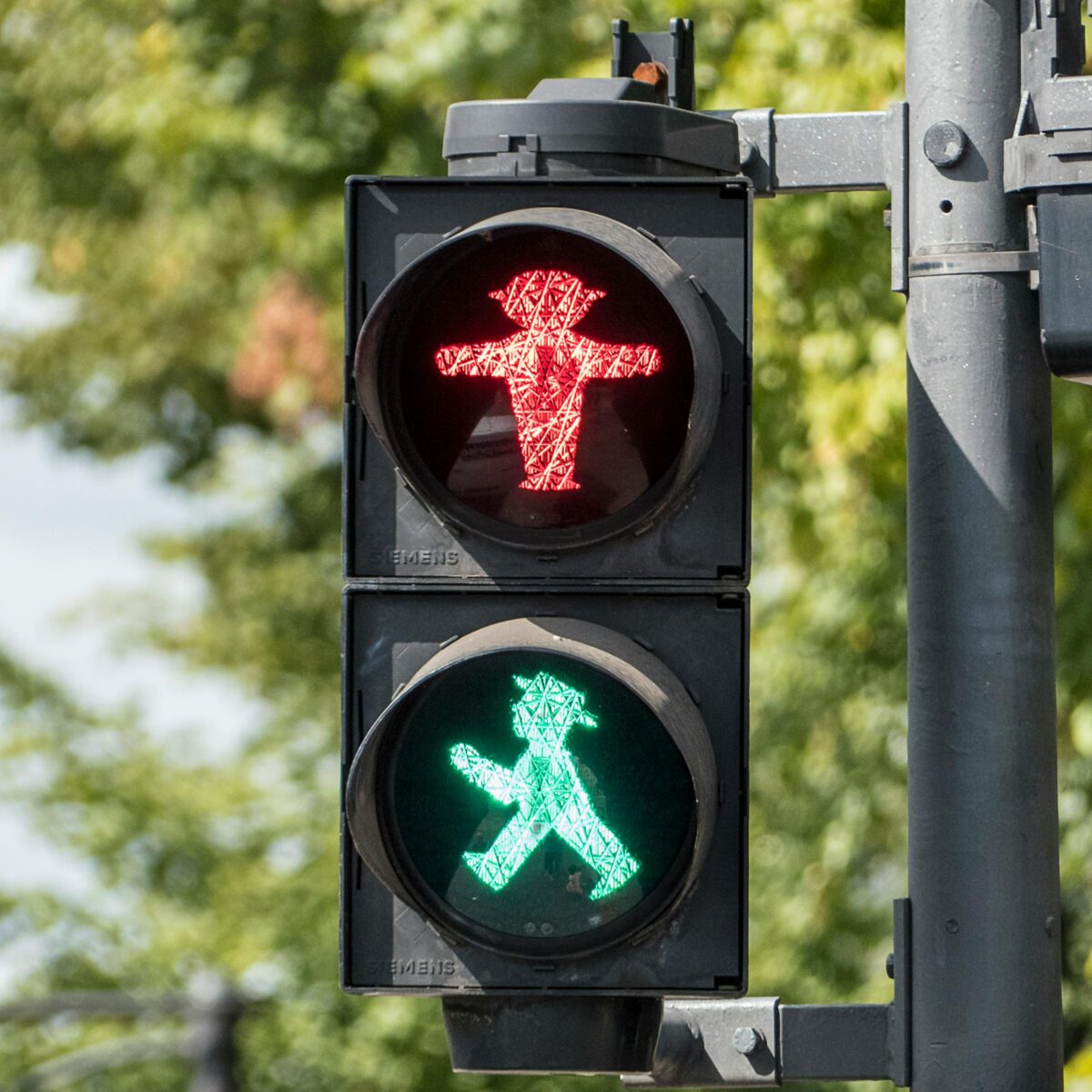
[Photo by Jos van Ouwerkerk from Pexels: https://www.pexels.com/photo/selective-focus-photography-of-traffic-light-1616781/]