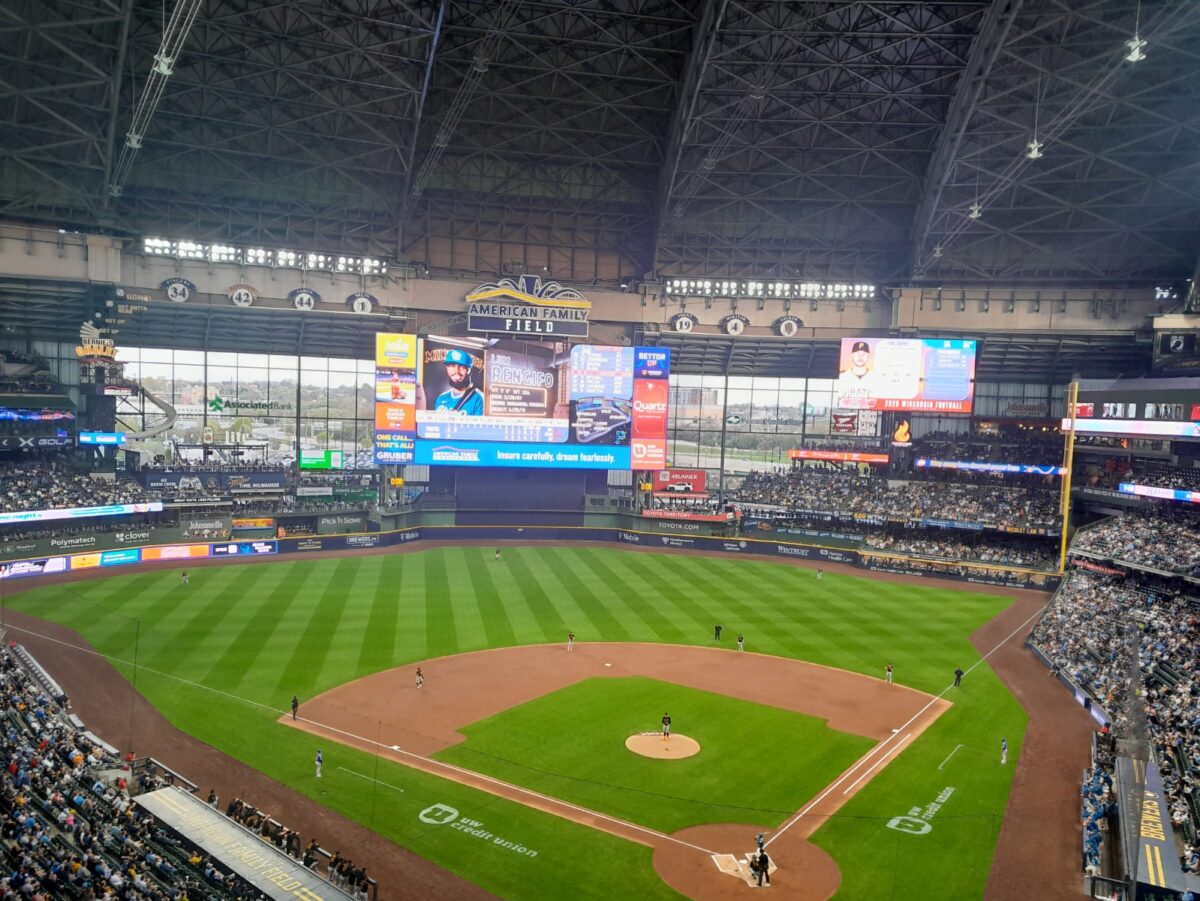
Last month I had to opportunity to visit the United States of America. I met some wonderful people, had fantastic hosts, and enjoyed my time with an excellent group of other international guests. I also went to a ball game which I didn’t understand (see picture), but my inner anthropologist had a field day.
I always feel very European when I am there. I left with many questions, a good thing. Asking questions is a way of trying to make sense of my experience. While experiences happen in the interaction between things outside us and our responses to them, reflection happens in the space beyond the experience, the space in which we ask what?, how?, and why?
What is this thing out there, which triggers some of these questions? It is ‘america‘, an idea which this time around posed the question: how on earth is it possible to find so much goodness and ugliness, grace and excess, such joy and depravation, all in one place? I can’t answer this question here, but I can tell you where this question emerged.
A light switch is a thing
A light switch is a thing. You push a button and there is light, or it goes off. You do something and something happens. Unless you don’t, because it is actually a sensor under your bed which controls the floor level lighting guiding you to the bath room at night. So convenient. This invisible automatic light switch is my symbol of America. It exists in a hotel in Milwaukee, and in countless other places.
The phantom switch reveals a frictionless culture, the culture of the smooth consumer experience. Anything that reminds us of effort, work, labour, and the natural friction of bodies interacting with other objects is taken out of the experience.
Hold on, you might say at this point, is switching on the light because you need to pee in the middle of the night an ‘experience’? No it is not, but it can be turned into one if you make it effortless. It creates a situation in which I stepped out of bed in the middle of the night and found my way in an unknown place without any effort. So I ended up in the ‘restroom’, after a short walk which was stripped of effort. (Isn’t it delicious how our euphemisms hide the unsayable in plain sight?)
What kind of experience is this?
What kind of experience is this disembodied and disengaged non-activity of me, in which I don’t even think about the electricity I consume, because light is ‘just there’. Why should I want to be disembodied this way? And how can I value the light, if it requires no effort, not even the flip of a light switch? Or do they, the experience designers, think I can’t figure out which way to go when I need to go there?
Somewhere along the line, ‘serving the customer’ flipped over into treating them as a child. Somewhere along the line, hospitality became an industry featuring excessive handholding of ‘consumers’ who can’t bothered which trivialities such as finding a light switch. But why? and at what price? These questions kept me awake that night in Milwaukee.
Why we keep asking questions
A light switch might be a trivial thing, but our technological artefacts reveal more than we see at first glance. This is why we need to keep asking questions about technology. Not only to critique what they do to us, not just to wrestle with how to use them well, but also to see who we are when we look in the mirror of the technologies we come up with. And these questions are universal, in particular in a global world. Thanks to the experience that night in Milwaukee, I was once again reminded of them.
[Own photo.]